

AI Agent Component Spec
AI Agent Component Spec
| Field | Value |
|---|---|
| Package | @cometchat/chat-uikit-react |
| Peer deps | react >=18, react-dom >=18, rxjs ^7.8.1 |
| Init | CometChatUIKit.init(UIKitSettings) — must resolve before login() |
| Login | CometChatUIKit.login("UID") — must resolve before rendering components |
| Order | init() → login() → render. Breaking this order = blank screen |
| Auth Key | Dev/testing only. Use Auth Token in production |
| SSR | CometChat requires browser APIs — use dynamic import with ssr: false |
| CSS | @import url("@cometchat/chat-uikit-react/css-variables.css"); in global CSS |
| Calling | Optional. Install @cometchat/calls-sdk-javascript to enable |
| Other frameworks | React.js · React Router · Astro |
Prerequisites
You need three things from the CometChat Dashboard:| Credential | Where to find it |
|---|---|
| App ID | Dashboard → Your App → Credentials |
| Auth Key | Dashboard → Your App → Credentials |
| Region | Dashboard → Your App → Credentials (e.g. us, eu, in) |
Step 1 — Create a Next.js Project
Step 2 — Install the UI Kit
- npm
- yarn
@cometchat/chat-sdk-javascript automatically.
If you want voice/video calling, also install:
Step 3 — Initialize CometChat
- TypeScript
- JavaScript
Step 4 — Login
After init resolves, log the user in. For development, use one of the pre-created test UIDs:cometchat-uid-1 · cometchat-uid-2 · cometchat-uid-3 · cometchat-uid-4 · cometchat-uid-5
- TypeScript
- JavaScript
getLoggedinUser()checks for an existing session so you don’t re-login unnecessarily.login(uid)skips the API call if a session already exists and returns the cached user.- Components must not render until login resolves — use a state flag to gate rendering.
For production, use
loginWithAuthToken() instead of Auth Key. Generate tokens server-side via the REST API.Step 5 — Add the CSS Import
Add this line at the top of your global CSS file (e.g.globals.css):
globals.css
height: 100% on the root elements:
globals.css
Step 6 — Choose a Chat Experience
Integrate a conversation view that suits your app’s UX. Each option below includes a live CodeSandbox demo and a step-by-step guide.Conversation List + Message View
Two-panel layout — conversation list on the left, messages on the right. Think WhatsApp Web or Slack.- Two-panel layout with conversation list and active chat window
- Switch between one-to-one and group conversations
- Tap-to-view on mobile — tapping a conversation opens the message view
- Real-time updates and message sync across sessions
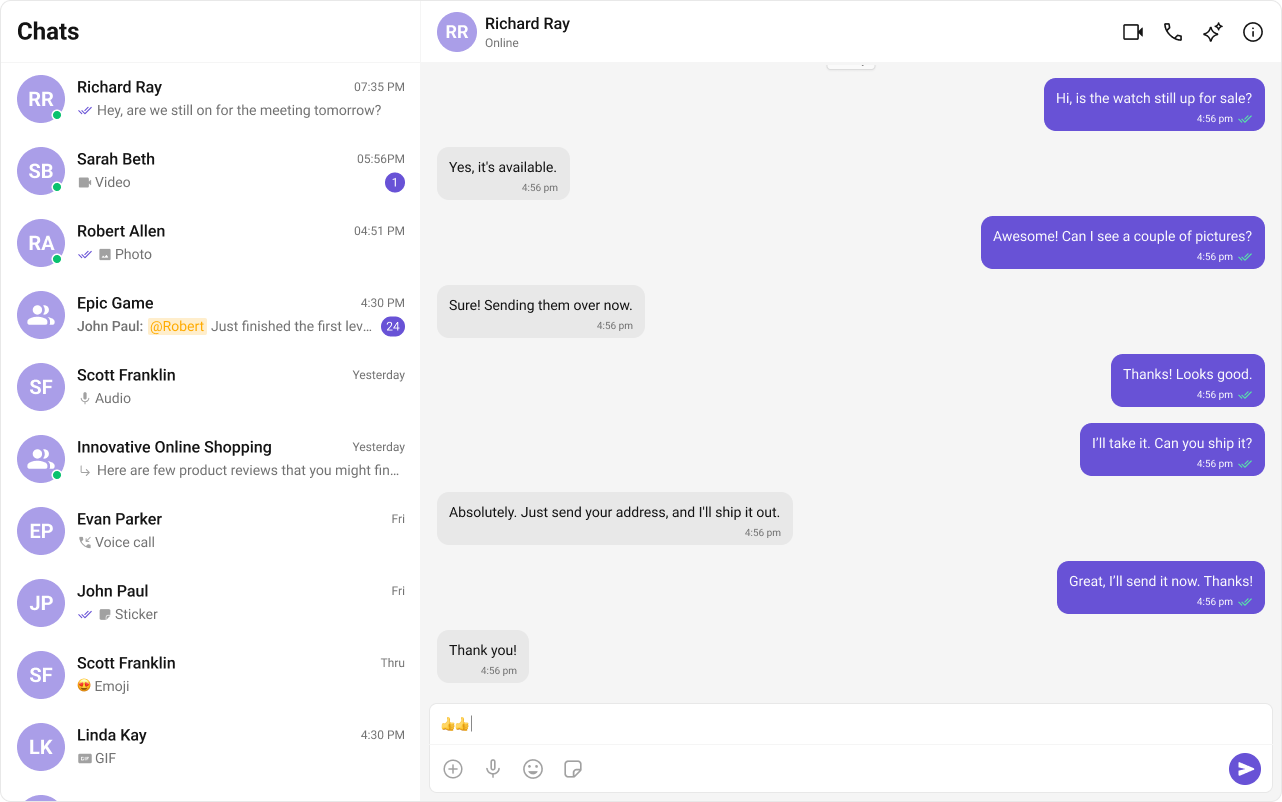

Fork the sandbox, insert your CometChat credentials (App ID, Region, Auth Key), and preview the UI in real time.
Build Conversation List + Message View
Step-by-step guide to build this layout
One-to-One / Group Chat
Single chat window — no sidebar. Good for support chat, embedded widgets, or focused messaging.- Dedicated chat window for one-on-one or group messaging
- No conversation list — users go directly into the chat
- Full-screen experience optimized for mobile
- Ideal for support chat or community messaging

Fork the sandbox, insert your CometChat credentials (App ID, Region, Auth Key), and preview the UI in real time.
Build One-to-One / Group Chat
Step-by-step guide to build this layout
Tab-Based Chat
Tabbed navigation — Chat, Call Logs, Users, Settings in separate tabs. Good for full-featured apps.- Tab navigation between Chat, Call Logs, Users, and Settings
- Full-screen messaging within each tab
- Unified experience for conversations, call history, and settings
- Scales well for adding future features like notifications or contacts
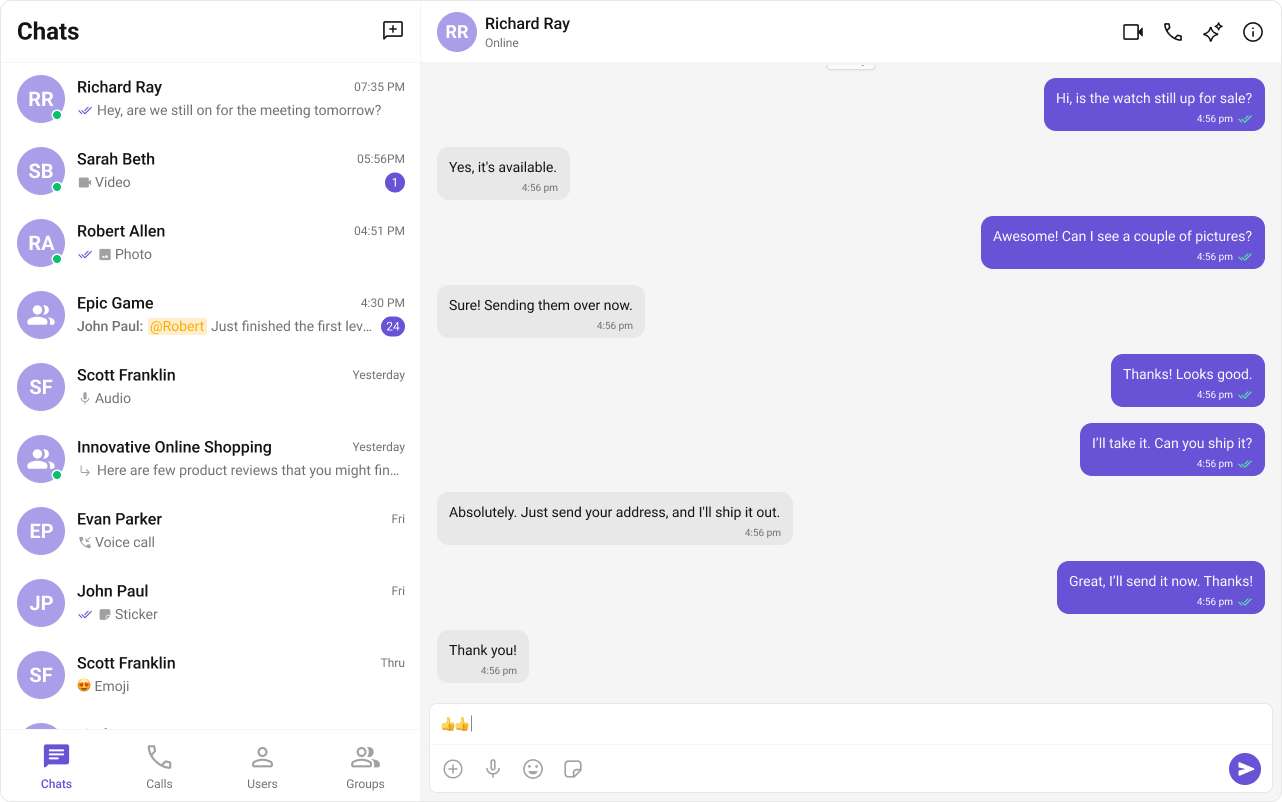
Fork the sandbox, insert your CometChat credentials (App ID, Region, Auth Key), and preview the UI in real time.
Build Tab-Based Chat
Step-by-step guide to build this layout
Build Your Own Chat Experience
Need full control over the UI? Use individual components, customize themes, and wire up your own layouts.- Sample App — Working reference app to compare against
- Components — All prebuilt UI elements with props and customization options
- Core Features — Messaging, real-time updates, and other capabilities
- Theming — Colors, fonts, dark mode, and custom styling
- Build Your Own UI — Skip the UI Kit entirely and build on the raw SDK